Solo Exhibition "NEW DIMENSIONS"
2018.7.6 - 7.29
ART FRONT GALLERY

A solo exhibition held at Art Front Gallery. Based on the virtual world “inner space” constructed within the computer, Harada translated its structure into painting and expanded it into physical space. By reconstructing the gallery within the virtual environment and incorporating sculptural elements, she presented a nested spatial structure in which the virtual and the real intersect. The exhibition reconsidered the site-specificity that painting has lost through the portability of the canvas, and sought to reconfigure its relationship with the exhibition space.


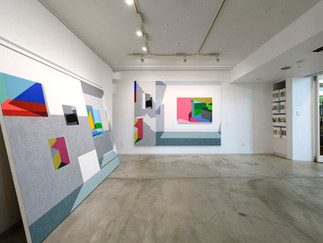

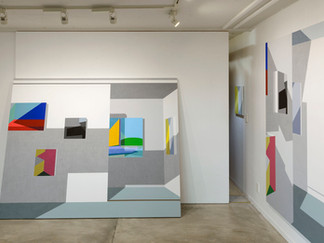


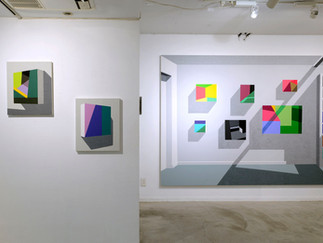


Photography: Hiroshi Noguchi Provided by: Art Front Gallery


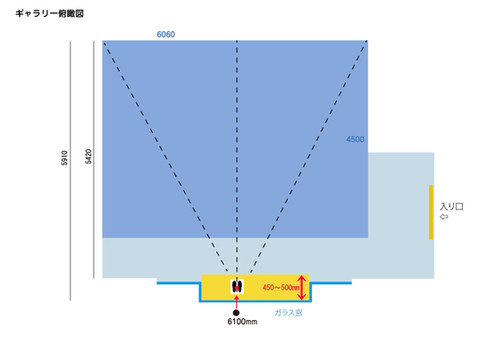


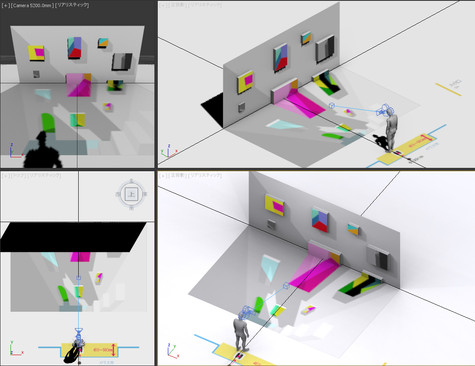
Planning diagram
Windows as Paintings that Construct PlaceTaro Igarashi (Professor, Tohoku University / Architectural Historian and Critic)
Windows and paintings share the same semantic function: both reveal a different world within a closed enclosure. Of course, a window makes visible the external reality outside a room by opening a hole in the wall, whereas a painting creates a virtual space within its frame. Some of the wall paintings in Pompeii depict landscapes, and they were arranged much like windows. Interestingly, in 17th-century Holland, not only windows but also paintings were covered with curtains, a condition that can also be observed in trompe-l'œil works of the time. It is also well known that René Magritte produced works that suspend the question: is this a window, or a painting? Today, computer and television screens serve a similar role. Whereas cathode-ray tube displays once had a tangible materiality as masses of glass, they have now shifted to large, thin, flat screens that likewise introduce another world into the room. However, the pictorial image can depict any arbitrary landscape, independent of the specific place of exhibition.
In contrast, a window reveals what can be seen from a particular place. In this sense, the paintings of Iku Harada, which introduce site-specificity, may be described as “window-like.” In architecture, large glass surfaces became technically possible only in the modern era, yet in this exhibition, she transforms entire walls into windows—paintings. Indeed, even the floor itself becomes a window-painting. In another gallery space, through a series of paintings, a virtual place is superimposed onto the real exhibition space. It is also significant that Harada’s works are not realist paintings. Since the Renaissance, painting has pursued the reproduction of real space within two dimensions through perspective. Her paintings, however, are unmistakably of the computer world. In other words, while connected to real places, they do not imitate reality but instead allow another world to intrude into the real.
Incidentally, I once encountered a scene at Legoland where life-sized figures and animals made from assembled blocks coexisted with real people, giving a sense of the coexistence of reality and a data-like space. Although human figures are absent from Harada’s paintings, might there be a sense that something is gazing back at us from the other side?
NEW DIMENSIONS
Venue: ART FRONT GALLERY
Cooperation: Kowa Sign Co., Ltd.